
For PTs, OTs, orthotists, and
medical professionals
For PTs, OTs, orthotists, and medical professionals
Bring clear orthotic thinking to every child on your caseload.
A practical pediatric orthotics course from a working orthotist. Designs, naming, donning, troubleshooting, and case studies, in about 3 hours 55 minutes of video.
A practical pediatric orthotics course from a working orthotist.
Designs, naming,donning, troubleshooting, and case studies, in about 3 hours 55 minutes of video.
You choose what to give. Your gift pays for
orthotic care for children whose families can't afford it.
6
Modules Included
3h 55m
Of Video Content
CEU
Eligible With A Final Exam
Give
$37, $97, $197, or
your amount
Most clinicians were never taught this part well.
In a 2025 survey of 207 pediatric physiotherapists, fewer than half rated their own orthotics knowledge as good. Source: Medicine, 2025
That is not a personal failing. Orthotic design names are confusing. Brace orders are hard to read. Families ask questions the training never covered.
So decisions get made on habit, and conversations with the orthotist and the family stay shallow.
Taught from the fitting room, not the textbook.
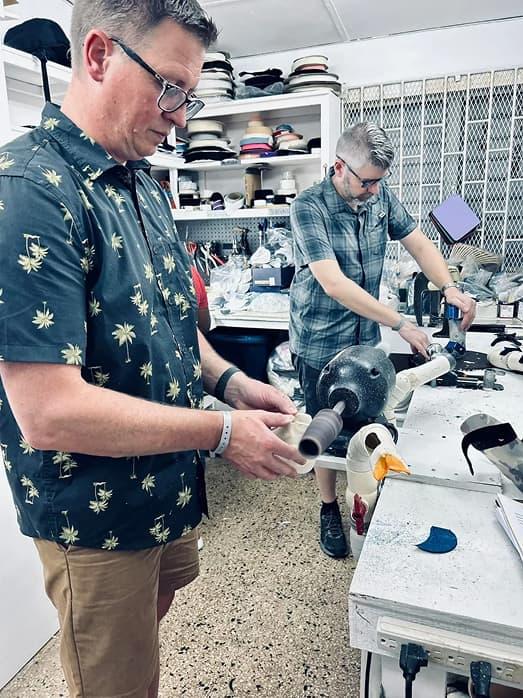
Gabe Beversluis has fit braces on children for over twenty years. You get his working vocabulary for orthotic designs, his approach to new braces and break-in, and his own case studies of how a design changes as a child changes.
You also get honest pros and cons of products, so you can discuss options with families and orthotists.
Five modules.
Every lesson gives you something to use.
Most advice starts with the brace. This course starts with your patient.
We call it the Three-Goal Check, and you can use it on any plan, including a plan to wait and see.
Module 1: Foundations
Judge any bracing plan against clear goals. (1h 05m)
The three goals (9:17)
The three goals every bracing plan should serve: better function, protected alignment, and room to develop.
Too much brace or too little (12:07)
Define overbracing and underbracing, and judge whether a plan leaves a child room to develop.
Muscle tone made simple (5:20)
Why joints that move too much need support, and muscles that are too tight need stretching.
Pronation and supination (9:52)
How feet collapse or rise under body weight, and why alignment comes first.
Ten insider tips (28:28)
Ten practical habits for working with families and care teams, from tracking function to choosing a provider and setting goals.
Module 2: Orthotic care, names, designs, and uses
Speak the language and compare designs with confidence. (1h 36m)
Break-in period and troubleshooting (10:50)
A step-by-step break-in approach for new braces, the skin checks to make, and how to make sure every caregiver puts the brace on correctly.
Understanding the names for common orthotic designs (14:39)
Decode foot orthoses, SMOs, AFO types, KAFOs, HKAFOs, and TLSOs, so you and your orthotist mean the same thing.
Orthotic design, part 1: starting at the floor (24:18)
Review over- and underbracing, then compare foot orthoses, UCBLs, SMOs, and articulating AFOs, including when a design can cause problems.
Orthotic designs, part 2: all types of AFO designs and features (18:35)
See how ankle joints, stops, leaf springs, solid ankle designs, and ground reaction AFOs work, and how trim height and ankle angle change the result.
Orthotic designs, part 3: KAFOs and HKAFOs (11:58)
Understand when and how bracing extends above the knee.
Night stretching AFO options (16:09)
Five features that matter in a night stretching AFO, a comparison of the DASS and Cascade #9 designs, and how to track tension step by step.
Final review exam (Quiz)
Test what you have learned.
Module 3: Instructional videos for AFOs and SMOs
Show families how to put braces on correctly. (21m)
Donning toe-walking SMOs (1:52)
Surestep SMO and AFO donning, for parents and providers (5:38)
DASS night stretching AFOs: donning and use (7:14)
Cascade #9 night stretching AFOs: donning and use (6:24)
Module 4: Case studies and in-depth opinion
See how an experienced orthotist reasons through real situations. (43m)
Toe walking SMOs (6:10)
From standing to walking: changing design to match progress (3:29)
Putting an AFO on a child with strong plantar flexion and pronation (3:28)
Custom wrist hand orthosis: resting hand vs functional (9:43)
Custom molded static stretch knee splints (5:41)
Dynamic night stretching knee orthoses for severe contracture (8:32)
Basic TLSO design options: anterior open vs bi-valve (5:45)
Module 5: Orthotic product reviews and explanations
Honest pros and cons from clinical experience. (10m)
Prefabricated carbon fiber AFOs: pros and cons (3:36)
Dynamic night stretching AFOs and the long-term low-load stretching approach (6:42)
You have probably sat in this appointment before.
You want the bracing to work as a therapy tool and need to know the characteristics of different design.
You have recommended a brace and wondered whether it was the right design.
You have watched a family struggle to put a brace on, or stop using it, and wanted to help.
You know you want specific support, but don’t know exactly what to request.
This course closes those gaps, one lesson at a time.
What parents and professionals say.
“I have been taking my 9 yr old daughter to orthotics appointments her whole life. I have never learned as much about her condition as I did during our first appointment with Gabe.”
"I am both a pediatrician and parent of a child who needs SMOs. Gabriel’s course gives me a deeper understanding of the different options available for my son and for my patients. I recommend all parents watch his “Top 10 Tips” for sure!”
“Gabe explained the pros and cons of different bracing options would work for my son and we made the best choice for his development. Knowing the different designs and the reasoning behind the recommendations allow us to evaluate how they are working and work together to get them changed if needed.“
The night-stretching AFOs Gabe recommended are working much better. He can actually sleep in them and I can see progress. Thank you!"
“Love it. This course has been such a helpful adjunct to trying to look things up here and there, or in my PT textbooks. So great to see the options in action!”
Give what you choose.
Get the whole course.
All five modules, about 3 hours 55 minutes of video
Case studies, product reviews, and a final exam
CEU-eligible
Choose $37, $97, $197, or another amount
Your gift supports Pediatric Orthotic Global Outreach (EIN 33-3063028), which provides orthotic care to children whose families cannot afford it.
Frequently Asked Questions
Are donations tax-deductible?
Yes, they are Tax-deductible donations.
Pediatric Orthotic Global Outreach (POGO) is a registered 501-c3 non profit organization. All donations made through Pediatric Rehab Lab go directly to POGO to help her provide support to children with disabilities around the world.
Is there really a minimum donation?
Minimum donation is $37. It gets you full, lifetime access to every module.
How do I access the course?
When you donate any amount, you will be redirected to account creation screen where you can set your password and get access to the course.
How Will I Know If This Information Applies To Me/My Child?
That’s a great question. We do not know you or your child personally and cannot give specific advice for your child’s needs today. This course is not intended to give medical advice for your child.
This course is intended to provide education about the most common challenges that are faced with children who are struggling with mobility.
It is designed to provide you as the parent or medical provider with the information you need to be able to ask the right questions, understand the options available, pursue the right strategies and, find the right team to help you—help your child.
How Do You Know What The Right Option Is For Supporting And Helping My Child?
This is a very good question and one that needs to be worked through with experienced medical providers, and, sometimes-some trial and error.
The most important thing to remember is that each child is unique and might respond in a different way than another child with a similar condition.
This course will help you to recognize when your child is not responding as hoped, and help you pursue options to try a different approach that might work better.
My Son Is Diagnosed With Developmental Delay. Is This Course Just For Certain Age Kids Or Certain Diagnosis?
We can’t guarantee that this information will give you the answers you need but it should certainly help you to rule some options in or out as being the cause of her struggle.
Some of these issues are even unknown to many medical professionals This course will help break down and explain complex medical challenges are very common with children struggling or delayed with movement.
You’ll be able to see and understand how and why the muscle tone and bone structure may be causing more problems…And what resources are available to help.
Does This Information Apply To Adults, Or Just For Kids?
The answer is yes and no… Many of the topics discussed here do certainly apply to adults and children.
Adults who struggle with mobility and use/need orthotic care will certainly benefit from the information inside.
There are differences though in the amount of impact we can have with adults sometimes.
Children’s bone and joint structure is not yet formed and their future development often depends on the quality of care they receive while growing and developing.
We are talking about a complicated discussion regarding CORRECTING deforming forces with children. Children are more malleable and we are often more able to guide growth and development away from deformity.
Adults, and even older children are sometimes unable to fully correct deformity due to the level of growth and ossification which has already occurred.
With adults we can certainly make orthotic care which Is very supportive and helpful! But, in many cases we might need to ACCOMMODATE deformity.
The sad fact is that the older we get and the longer a limb is in a deformed position, the harder it can be to correct and “undo” damage which might have occurred.
Many of the strategies outlined in this course have certainly been helpful for adults, but, they may need to be modified for a balance of accommodative and corrective support.
I Am Not A Doctor Or Nurse, Will I Be Able To Understand The Info In This Course?
This course will be most helpful to MDs, DOs, Nurses, PTs, OTs AND parents/caregivers who want more in-depth information.
We have intentionally made the content easy to understand for everyone! You do not need to have medical credentials.
This course includes important foundational information as well as in-depth descriptions with pros/cons of all types of orthotic designs available.
This course also includes in-depth case studies regarding many of the new orthotic options available.
In the future there will be an “Advanced Medical Professional” course which will include all of the information in this course PLUS we will cover:
-casting position
-Posting: when and how to use it
-Toe-Walking treatment strategies
-Case studies
-Fabrication and modification techniques
-Understanding pressure problems, function problems
-Trouble shooting when problems arise
For those who complete this course and are interested in more advanced topics, the Advanced Professional course will be offered with a discounted price.
Is This Program Eligible For Continuing Education Units And CME?
Yes! As part of this course, you will be able to complete the final quiz and receive a certificate to submit for up to 4 credit hours of continuing education!
Which Type Of Medical Professionals Is This Course Designed For?
This course is designed for all medical professionals who may be involved with assisting children and their families.
This course provides plain-English advice for all families working through mobility challenges or orthotic bracing.
Learn something useful. Help a child get a brace.
Five videos. The Three-Goal Check. Two lenses for tone and foot alignment.
Ten practical habits for appointments. Start now, finish when you can,
and bring your questions to your child's care team.
Five videos. The Three-Goal Check. Two lenses for tone and foot alignment. Ten practical habits for appointments. Start now, finish when you can, and bring your questions to your child's care team.
Five videos. The Three-Goal Check. Two lenses for
tone and foot alignment. Ten practical habits for appointments. Start now, finish when you can, and bring your questions to your child's care team.
Education only. Not medical advice for any individual patient.

Hello!
I'm Gabriel Beversluis CO, LO
As a board-certified orthotist, I have dedicated my career to helping thousands of young patients—not just by providing effective treatments, but by delivering the critical information families need to achieve the best possible outcomes.
For over 20 years, I have been on a mission to transform the lives of children through specialized pediatric orthotic care. Through POGO, that mission goes global.
We are driven by a shared hope to dramatically improve pediatric orthotic care worldwide, ensuring that children everywhere—regardless of geography—have access to the life-changing resources they deserve.
As a pediatric orthotist, I design and fit custom orthotic bracing that restores mobility, independence, and confidence in children facing physical challenges.
My passion, and the core vision of POGO, ensures that every child receives care as unique and limitless as they are.
© 2026 Pediatric Rehab Lab. All Rights Reserved.